Category: Uncategorized (page 1 of 4)

Artificial Intelligence and Machine Learning - What does it mean for the built environment?

Share This:

thinkBIM Webinar

Wednesday 30th September 2020 | 13:00 to 15:00

Free

Following on from our last event looking at Digital Twins, thinkBIM is pleased to be exploring another well used but perhaps poorly understood set of terms currently appearing in articles on the digital transformation of the built environment industry. Artificial intelligence is an overarching term for describing when a machine mimics human thinking, like problem-solving, pattern recognition, and learning. Machine learning is defined as a subset of Artificial Intelligence using statistical techniques to give computer systems the ability to “learn” from data, without being explicitly programmed. Join us on the 30th for our interactive panel discussion and presentation looking at what these terms mean for our industry.

Our presenters include;

*JUST ADDED* Aviv Leibovici, Chief Product Officer and Co-Founder, Buildots

Aviv comes from a background of data-heavy cyber security systems, and leads the company’s product development and the relationship with the UK construction industry.

Natalia Wojtowicz, Computational Design Specialist, Grimshaw

Natalia is a specialist working across the fields of computational design, applied machine learning, software development, environmental design and data-driven strategies.

 Chris Pilling, Principal Consultant, Fujitsu Digital Business Services

Chris has 25 years IT & Tech industry experience and joined Fujitsu in 2016 as EMEIA Principal Consultant. In 2017 he co-founded Fujitsu’s Blockchain Innovation Centre in Brussels which works with customers to define strategy for this emerging paradigm. Chris is at the forefront of helping customers understand and adopt Fujitsu’s Quantum Inspired computing services and capability.

In addition we are pleased to have Becky Dodds from Agri-TechE to give an overview of how Artificial Intelligence and Machine Learning are being used in the agriculture industry too.

New online format!

We are pleased to announce that the format of this online event will include a series of polls for our attendees to support a panel debate on Artificial Intelligence and Machine Learning. Another great way you can get involved with thinkBIM!

Booking

The link below will take you to our Eventbrite booking site. Once you have signed up a joining email will be sent to you with the link to join the webinar.

https://www.eventbrite.co.uk/e/artificial-intelligence-and-machine-learning-thinkbim-webinar-tickets-121215309253?aff=ebdssbonlinesearch

With thanks to our sponsors

Buildots solve one of the biggest challenges in construction management using an AI-based approach. Find out more at https://buildots.com/

Digital Twins - What are they, why do we need them and if you want one, how do you get started?

Share This:

Many thanks to all those that tuned into our webinar on Digital Twins on 20th May 2020. For those that missed it, we have published all the videos from the event on the School of Built Environment, Engineering and Computing YouTube channel at the links below.

These videos should help answer some of the above questions but do keep checking our blog for our follow up thought pieces on the issues raised.

BIM and Digital Update - Duncan Reed, Chair of thinkBIM and Trimble

The National Digital Twin Programme - Mark Enzer, Centre for Digital Built Britain

Don’t get triggered by Digital Twins - John Adams, Glider BIM

The importance of knowing why? - Vicki Reynolds, i3PT Certification

The value of being fashionably late - George Mokhtar, Turner and Townsend

Online Q & A with our speakers - Chaired by Duncan Reed, Chair of thinkBIM

Challenging Digital Twins - Pre-recorded interview with Maria Villanueva, Jacobs Engineering

Twitter Stream

If you want to read the tweets from the afternoon these have been collated at following link. https://wakelet.com/wake/dC-3Ze-nJ6YUbiRFvl72W

For more videos like this, please subscribe to the School of Built Environment, Engineering and Computing You Tube channel.

With thanks to our event sponsors GliderBIM
and our network sponsors Trimble

thinkBIM is going online! Join our webinar on “Digital Twins” on 20th May 2020

Share This:

@ Image taken from Centre for Digital Built Britain

Webinar

Wednesday 20th May 2020 | 13:00 to 16:00

Digital Twins

The term Digital Twin, whilst it has only become a popular term in the last couple of years has already earned itself the divisive status that BIM had previously held. So what do we really mean by the term Digital Twin?

Why do we need them?

Who is going to benefit?

And if you want one, how do you get started?

These, and other important questions around the next step in the digitalisation of the whole of the built environment will be addressed by our fantastic line up of speakers for our Summer Online Conference on 20th May 2020.

Mark Enzer, Digital Director, Centre for Digital Built Britain

John Adams, Digital Construction Strategist, Glider Technology

Vicki Reynolds, Head of Digital, i3PT Certification

George Mokhtar, Strategic Director, Digital Advisory, Turner & Townsend

Marina Villanueva, Technical Director Digital Engineering, Built Environment, Jacobs

Brought to you by our event sponsors Glider Technology.

CLICK HERE TO SIGN UP FOR THIS FREE WEBINAR

Digital Construction Week brought me here…

Share This:

WELCOME

Hopefully over the last few days you will have decided to visit our thinkBIM blog due to a conversation you may have had, or a leaflet you may have found at Digital Construction Week. Or maybe you were looking for BIM events in Yorkshire and came across us! Whatever your reasons, we are glad you have decided to pay our site a visit and let us take a moment to tell you a little but about us.

thinkBIM is an award winning network for Building Information Modelling (BIM) and digital construction advocates set up in 2011 by the Centre for Knowledge Exchange at the School of Built Environment and Engineering at Leeds Beckett University. We promote and accelerate the adoption of new digital technologies, products and processes throughout the built environment industry through an extensive programme of case study focussed events, guest lectures and half day conferences and seminars.

We also deliver guest speakers, consultancy and approved BIM training across the region to many businesses, organisations and educational facilities.

Now in our seventh year, we are supported in our endeavours by our proactive steering group of recognised leading early adopters and a network of over 2000 regional and national digital leaders.

UP NEXT

Living in a Digital World

Half day conference in association with BIM4Housing (Wednesday 5th December 2018, 12:00 to 17:00, Leeds).

GET INVOLVED

Join the debate on social media. You can follow our account @thinkBIM and keep up to date with live tweeting using the hashtag #tbim2018.

SIGN UP FOR OUR UPDATES

Join the Centre for Knowledge Exchange mailing list by clicking here

Please note, once you have registered you will be able to select which of our networks you are interested in hearing about; i.e. thinkBIM, Constructing Excellence Yorkshire and Humber, Leeds Planning School and others.

DATES FOR 2019 - PUT THEM IN YOUR DIARY!

Wednesday 13th March 2019

Wednesday 12th June 2019

Wednesday 2nd October 2019

Wednesday 4th December 2019


Dark and true and technological is the North: Digitising the region

Share This:

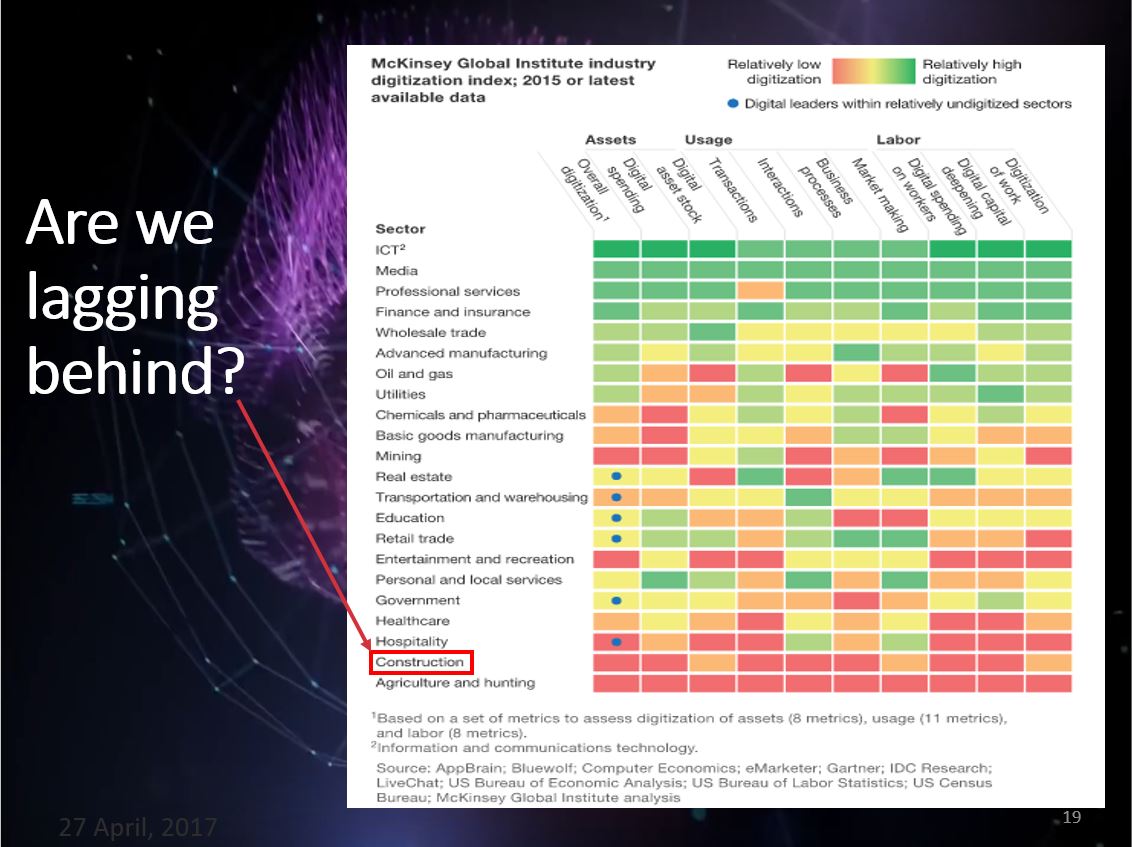
Screen shot from MyConsole presentation at Constructing Excellence breakfast event on 26th April 2017.

At a recent Constructing Excellence breakfast event we held, we were particularly struck by a statistic from a recent McKinsey Global Institute (MGI) study which proposed that in terms of digitisation, the construction industry lags dramatically behind those in other classically undigitalised sectors and in fact ranks only above farming and agriculture. Having been heavily involved in promoting digital construction across the region and beyond we felt that in light of this statistic it was important to explore our impression of where the industry is and specifically where Yorkshire and Humber currently places in order to meet the demands of the future.

We at Constructing Excellence Yorkshire and Humber (CEYH), part of the Leeds Beckett University School of Built Environment and Engineering have been running digitally focussed events through our thinkBIM network for over five years now and have overseen a massive growth in digital uptake across the region. Originally set up as a network to promote the advancement of BIM (Building Information Modelling) our remit has broadened to highlight new technologies and digital processes and their current and future uses.

When we started, the events were definitely for the innovators and early adopters, particularly in larger companies with SMEs being a little unsure of dipping their toe in the water; early problems being the choices of software available, balancing the cost of adoption with business needs and lack of clarity in contractual BIM requirements – all issues which we have had to address through events and targeted 1:1 support. As the network has expanded though, so has the industry’s understanding of the benefits of digital adoption, and this along with the publishing of the Digital Built Britain strategy in 2015 has helped to demystify some of the processes and improved knowledge and uptake of digital tools and processes across the region.

Even in these early days of digital adoption we saw how local organisations were at the cutting edge of the technological innovation that was unfolding. Not always on the large and prestigious projects but on smaller schemes like the laser scanning of the Orangery in Wakefield by DLA Design which showed what was possible already. We also witnessed the great work done by BAM at First Direct Arena working with their designers, structural steelworkers and precast concrete manufacturers who collaborated together using coordinated models form each organisation to resolve issues with the design, create and more effective design and improve the outcomes for the site team. By working together the team delivered an innovative and award winning venue for the city of Leeds.

Federated model image submitted by A1L2B, a Carillion Morgan Sindall Joint Venture, as part of their winning entry in CEYH Awards 2015.

The region has also seen the digitisation of infrastructure schemes too. The award winning A1 Improvement scheme from Leeming to Barton, a Carillion Morgan Sindall Joint Venture demonstrated many new and innovative ways to use digital data to assist with stakeholder engagement as well as collecting real time digital quality records during the course of the works too. Over at Immingham, Costain used the combined, federated, model of their scheme to accurately and successfully plan a 76 hour possession over Christmas 2015 where the team jacked a 5000 tonne bridge into place under the busiest freight railway line in the UK. All this was achieved by creating a digital programme that was meticulously planned, checked and reviewed by the project team, Highways England and Network Rail.

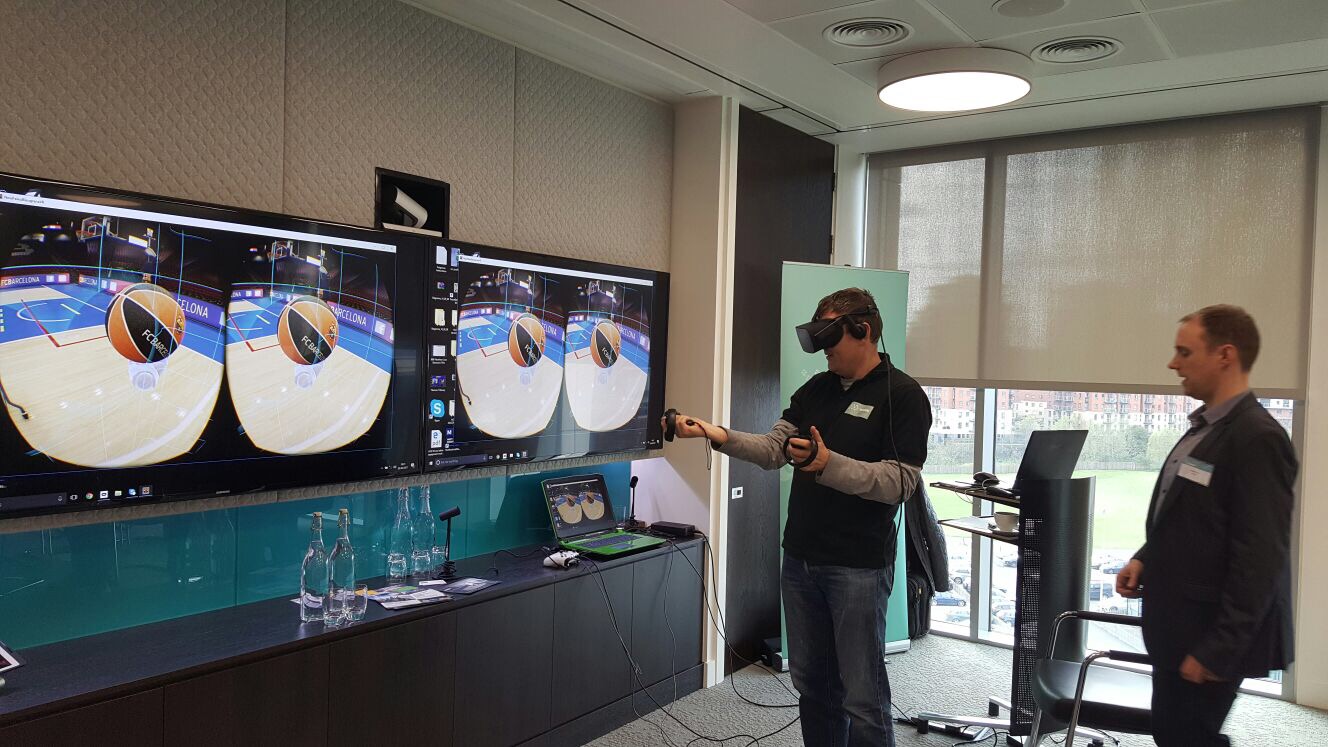
Solius Group virtual reality demonstration at thinkBIM conference in April 2017

More recently the thinkBIM network has been able to lift the lid on the future with demonstrations of Augmented Realities and Virtual Realities. These technologies are actually starting to become widespread too as more and more businesses start to see ways to use gaming technology for customer engagement, construction rehearsals and health and safety briefings as well as for operations teams to better understand the assets that they are maintaining with a level of efficiency previously unheard of. #itsBIMupNorth not just a hashtag but proof that Yorkshire really is a centre of excellence for the digital delivery of projects.

But the key thing here is not the technology, but the people behind it. As Steve Jobs once said “Technology is nothing. What’s important is that you have a faith in people, that they’re basically good and smart, and if you give them tools, they’ll do wonderful things with them”. From a niche group of technically minded people the thinkBIM network has grown to reflect and support a much wider community focussed on working more efficiently and who adopt a whole lifecycle approach not just procuring data for the physical asset alone. And here-in lies the challenge going forward, ensuring the industry is constantly recruiting and upskilling the individuals and teams who are able to exploit the opportunity technology offers.

Let us know your thoughts of where the industry is and where it needs to be and where you see the future of digital technologies for construction.

Clients, certification and the future – three important views on BIM

Share This:

Wednesday 14th June 2017

Twilight Seminar

17:30 to 20:00

Calverley Building, Leeds Beckett University, Leeds

CLINK HERE TO BOOK YOUR PLACE (diverts to Leeds Beckett online store)

We like to think of thinkBIM as the go-to place for great digital learning and this month we certainly feel we have put together a great line up of speakers.

Helen Thompson, Executive R&D Consultant at Gleeds and BIM Regional Champion for East Midlands will be talking on how Gleeds are helping clients to adopt BIM on projects, the lessons learnt to date and her views on what the next steps for industry should be.

Adam Horne, Business Development Manager, Construction and BIM at BSI will be outlining the BSI BIM Kitemark scheme and their BIM Verification Certificates that BSI have developed in line with the government’s Level 2 mandate.

We all know digital delivery is about the use of standards but how can you be sure that the businesses you work with really understand their roles and responsibilities?

George Mokhtar, Associate Director and Head of BIM at Turner & Townsend UK, offers us a view of the digital future speeding towards us - we need to talk about Level 3.

How might businesses need to change their views, plans and attitude to BIM/digital as they deliver assets that will be operated in a Level 3 environment?

BOOKINGS

Click here to book your place! (diverts to Leeds Beckett online store)

ThinkBIM Security - 7th December 2016

Share This:

December 2016’s ThinkBIM was particularly memorable for an eye-opening and occasionally frightening view of just how vulnerable the built environment might be to cyber attack, writes Paul Wilkinson of pwcom and thinkBIM Steering Group member.

In May 2015, PAS1192-5 – “Specification for security-minded building information modelling, digital built environments and smart asset management” – became the latest addition to the suite of UK BIM documents, and Turner & Townsend’s Nathan Jones gave us the benefit of a non-construction person’s view of this document. Nathan was recruited into the construction industry after working in the armed forces specialising in military grade IT and security-related technologies.

From his presentation and roundtable contributions, it was clear that he felt existing construction industry IT practices lag behind most other industry sectors in respect of security (“Often IT security is a bit backward in construction”).

This is, of course, hardly surprising. Within the living memory of many people still working in the sector, we mostly exchanged information by paper. But now, in the early years of the 21st century, we are increasingly sharing ‘electronic paper’ – emails instead of letters, Word documents instead of typed reports, PDFs or native files instead of drawings, etc. We already must be vigilant about security: guarding against software viruses, ‘phishing’, hacking, and theft or loss of devices, while also continuing to track, store and protect our communications and intellectual property. (And not always successfully: details of the internal layout of a Royal Palace were recently freely distributed to potential tenderers via an email attachment, Nathan said.)

However, the next stages in the digital transformation of the built environment sector are set to make information management more challenging from a security point of view.
 

From BIM to BASM

As firms begin to share and to combine or ‘federate’ data-rich 3D, 4D (time) and 5D (cost) models, project teams will need to heighten their cyber-security regimes.

A shared 3D model may expose intellectual property to competitors. Moreover, a walk-through visualisation of a new building might expose sensitive information about the building’s design – key structural components, locations of key building services, placement of CCTV or other security equipment, for example. Shared 4D models might reveal periods when assets might be susceptible to sabotage or sites could be vulnerable to theft, while a 5D model could reveal commercially sensitive pricing information to competitors.

Published by the British Standards Institute and the Centre for Protection of National Infrastructure (CPNI), PAS1192-5 is intended to help teams identify and guard against risks including:

  • hostile reconnaissance
  • malicious acts
  • loss or disclosure of intellectual property
  • loss or disclosure of commercially sensitive information, and
  • release of personally identifiable information.

And our already abbreviation-heavy glossary of BIM terms now includes BASM - built asset security management - as a new discipline. Early engagement with a BAS manager will help a project team and the asset owner develop a strong built asset security strategy (BASS) and management plan (BASMP), said Nathan.

People can be our greatest asset, but also our weakest link
Such measures will become more important in an increasingly connected world of not just ‘smart buildings’ but ‘Smart Cities’. We will need to protect information created during delivery of a new built asset, and – just as importantly, and depending on the asset’s sensitivity – protect some or all of the data created by the people and systems in and around that asset, and in any connected assets or infrastructure.

At the people level, precautions might include procedures limiting information access to those with defined roles (I was encouraged that Nathan identified that some Software-as-a-Service collaboration platforms do this well: restricting access to certain files, models or data only to people with defined responsibilities), supported by systems of passes, logins, keys or other forms of authentication.


BASM – it’s about people
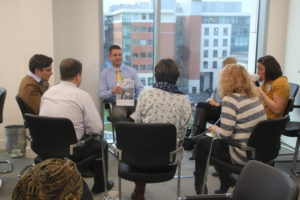
As with other aspects of BIM, this is certainly not just about technology, but people and process. Awareness raising and training will be important: working practices learned in the days of paper or “spray and pray” email will need to be amended, and data vulnerabilities addressed. Often the weak link will not be the software or hardware, but the people that use them (users noting passwords and PINs on Post-It notes next to their computers, for example), and, as risks cannot be entirely eliminated, Nathan also advised that organisations need plans and processes dictating how they will respond to security breaches.

In one of the roundtable sessions, John Lorimer asked Nathan if this heightened focus on security might counteract recent years’ efforts to get companies and people to share information more readily. “Security should not stop collaboration, so long as it is controlled and people are aware,” Nathan replied, “BIM is actually helping to trigger some security-minded conversations much earlier. We may soon be segmenting our construction supply chains according to those who are security-aware, and those who aren’t.”
 

Level 1 - the critical foundations to delivering on digital projects

Share This:


Here at thinkBIM we are very aware that there is still a great need to explain the fundamentals of working digitally to both new delegates as well as regular attendees. Despite surveys that suggest a huge and comprehensive uptake of BIM in the UK; the government mandate and numerous organisations proclaiming their ability to deliver Level 2 (or beyond – really??) we regularly meet lots of businesses still bewildered as to how and where they might need to start out on their ‘BIM journey’.

So cue thinkBIM’s November event; Level 1 – the critical foundations to delivering on digital projects. Hot on the heels of our fifth birthday party in September and our successful Government Mandate twilight event in October came a whole evening dedicated to a 40 page British Standard first published in 2007. But a geek-fest this was not, well not completely. BS1192:2007+A2:2016 Collaborative production of architectural, engineering and construction information – Code of practice to give the full title is absolutely fundamental to the concept of defining the rules of collaborative working and delivering projects digitally. You can download the standard here http://bim-level2.org/en/standards/

The scope of the standard is well considered, and when read in conjunction with the preceding Introduction makes it clear why the processes outlined in this document are fundamental to collaborative working practices. It really is worth reproducing these words here before we move on -

scope


So after all that what did we learn at the event. Well John Adams gave us a self-proclaimed wedge-free presentation. Three slides in we had the first obvious, but often over-looked requirement of Level 2 fundamentals – do Level 1 first! John walked us through the process of issuing documents around the process in the standard but reminded everyone of the following too

Buy CDE > Set Project Number > 4 Folders > WIP, Shared, Published, Archived does not equal a CDE!!

John’s final words about using the standard; don’t deviate – it ruins everything.

John’s slide deck: thinkbim-level-one-cde

After John’s presentation it was my turn to speak again at thinkBIM. In apparent wave of extreme geekiness I had decided to speak on Suitability Codes. Why – because in my opinion they are fundamental to the standard and the underlying collaborative working requirements that the standard advocates. Why you are issuing data, for what purpose, is as fundamental as actually issuing the data itself in my opinion and is important both contractually and practically. Even now I’m not sure that I’d got everything in my slides right, in fact the next presentation explained one specific part that I’d not grasped myself – a great example of where everyone learns at thinkBIM!

Duncan’s slide deck: suitability-codes

The third presentation of the evening came from Lee Chappelow from SES. After explaining how SES have set about creating and operating their own CDE Lee took us through 13 slides to explain how a document produced by the SES BIM team moves to published status. Now on the face of it this sounds horrendous; thirteen stages to just get a document approved but for me a lot of what Lee was saying is what good practice should look like and the thoroughness he was demonstrating is as much about an industry that has been so pressurised to deliver that corners are cut or risk just passed downstream rather than owned.

Lee showed us what good looks like, and what good as a digital workflow should be. Lots of food for thought and the feedback from the event certainly confirmed this too.

Lee’s slide deck: thinkbim-cde

Thanks to John and Lee for helping to deliver another great thinkBIM. In this case the slides seemed so important we have published them in full for you all to reference again as needed.

As a final post script I do accept that working in accordance with BS1192:2007 does look complicated and daunting but once you get to grips with the standard and start using it the processes do become easier. But it is still a bit of challenge – only a week after the event I had a 30 minute discussion with a contracting friend over the interpretation of just one of these suitability codes in the standard.

So as we said on the night – to use the standard effectively you must make sure the project team has a common understanding of the document – this may mean defining, explaining, agreeing and documenting how the standard is to be used in the BIM Execution Plan. But remember don’t alter it – otherwise then it’s not a standard.

thinkBIM - 2nd November 2016

#Duncan Reed, Chair thinkBIM

Delivering Digital Assets under the Level 2 Mandate

Share This:


October brought in the first event of our Autumn series and a return to The Rosebowl as the venue for our twilight seminar on how centrally procured departments are delivering Level 2 BIM Under the mandate.

The evening opened with a fantastic presentation from Cliff Jones, the Head of Construction Procurement, at the Department of Health. It was great to hear his measured, but equally challenging, view on how he see that BIM has - and more importantly should - be adopted in the NHS. Cliff made the very important point early on in his presentation that BIM isn’t an add-on; it has to be integral to the wider construction and business process of an organisation.


thinkbim-1He also noted that BIM = Lean but reminded the audience of what Lean really means – it’s not about cost cutting, it is about driving out waste.

BIM = Lean (NOT Cost Cutting – Improved Efficiency and Productivity)

  • The most efficient, effective and successful companies in other industries (and countries) have applied “lean” for decades;
    • Add value and remove waste;
    • Extensive use of developments in Technology supported by Digital Data.
    • Waste =
  • Processes/procedures that do not add value;
  • Use of resources (labour/plant/materials in a non-productive and therefore non value adding way;
  • Defects;
  • Unnecessary transportation;


Whilst the benefits of the P21+ and P22 Frameworks provided ample evidence of how collaborative working can improve outcomes it was some of the more nuanced comments that caught my attention. The DoH hasn’t mandated the use of BIM by the NHS as such as it understands that forcing something on Trusts won’t work - from the very start they have to want to do it. This was a very powerful point for me.

Cliff rounded up his presentation with some very real and useful points on how to adopt BIM on projects.

thinkbim2thinkbim3


Due to a last minute cancellation by our other speaker thinkBIM showed its agile credentials by organising Steering Group member Tom Oulton to review the recently published Ministry of Justice (MOJ) BIM documentation. These documents can be found here http://bit.ly/29b13Kq

The MoJ launched their Client Best Practice Guides in June this year but like many other things associated with BIM development not everyone in the audience was aware of their existence. They were developed by the client led BIM2AIM Special Interest Group, in a process led by Matthew Watchorn, MoJ Head of BIM. In an article in BIM+ recording the launch event of the documents Matthew is quoted saying -

“Dismantling, examining and jointly rebuilding the EIR suite of standards from the bottom up was a fundamental moment in the MoJ BIM story and will stand us and other government departments in good stead in making the next phase of BIM a reality for projects going forward”

It always strikes me as a bit strange that the industry seems to clamber for examples or Case Studies about BIM only to then complain about anything that is produced. Personally I feel that the industry shouldn’t keep shooting at those people or organisations that do stick their heads over the battlements. It might not be perfect but at least they have published something. But Tom is a good judge of BIM character and led a spirited, yet balanced, discussion over the merits of these documents.

With just a few days to review the SES, OIRs, PLQs, EIRs, and BEP template Tom chose to rate the documents overall using that tried and tested metric of the spaghetti western standard. So - were these documents Good, Bad or Ugly?

thinkbim4

Tom gave his views of the following documents that have been publically shared by the MoJ;

    • Shared Estates Service (SES)
    • Organisational Information Requirements (OIR)
    • Plain Language Questions (PLQs)
    • Employer’s Information Requirements (EIR)
    • BIM Execution Plan (BEP) Verdict – GOOD. Verdict – Good…but…Would like to see the Common Data Environment (CDE) addressedOIRs The OIR lays out the context but falls short of stating specific requirements. Verdict – BADThree fully populated EIRs should be provided, preferably with real examples for eachBEP The document is easy to follow
    • But Tom felt that the CDE should be owned by MoJ (and I agree)
    • Verdict – Good
    • The Shared Estates Services introduces the Gold, Silver and Bronze projects – but only one EIR
    • EIRs
    • Reads like a guidance document, not the actual document.
    • Verdict – good & bad…
    • Would like to see COST addressed prior to Stage 2 PLQ
    • PLQs
    • The guide nicely sets the scene for BIM
    • Shared Estates Services;
    • And the results from Tom’s review?

It was great to see the audience engage with the speakers in the Q and A sessions and reminded me of the importance of letting our delegates find out what is important to them around the themes discussed.

This format will be extended even further in our Autumn series conference, on December 7th, when we will be offering even more roundtable sessions all focussed around Case Studies – so just what the industry still seems to need.

But before then we are pleased to be hosting a Level 1 BIM event on November 2nd. We all (should) know of the importance of working in accordance with BS1192:2007+A2:2016 but how many of us really apply the standard correctly? Check out your knowledge at this great opportunity to understand one of the bedrock standards for UK BIM that is now expected to be rolled out across Europe and beyond.

thinkBIM blog, October 2016.

#Duncan Reed, Chair thinkBIM


We need to talk about Level 1 - the critical foundations to delivering on digital projects #tbim2016

Share This:

bimdocumentdatamanagement

ThinkBIM Design and Pre Construction 2016

Level 1 - the critical foundations to delivering on digital projects

Wednesday 2nd November, Leeds

17:30 for registration, 18:00 to 20:00

We all know that in order to ‘do’ BIM you need to work in accordance with BS1192:2007 + A2:2016 but how well do we all really know how to use this standard? This event is focussed around getting to grips with the apparently complex container numbering, understanding the purpose of issue and suitability codes as well as explaining who/who/how is a Common Data Environment.

We are pleased to announce our first two speakers; John Adams, Head of BIM Services at BIM Strategy Ltd and Lee Chappelow, BIM Operations Manager at SES Engineering Services.

A back-to-basics event to explain/remind/help our network understand how to work collaboratively.

Remember - if your business can do Level 1 then you can work on a Level 2 project.

We need to talk about Level 1. Are you getting the BIM basics right? Find out at #tbim2016 on 2nd Nov!

Room 538, Lecture Theatre D, 5th Floor, The Rose Bowl, Leeds, LS1 3HB

Click here to book your place!

bimsponsors

Older posts

© 2020 ThinkBIM

Theme by Anders NorenUp ↑